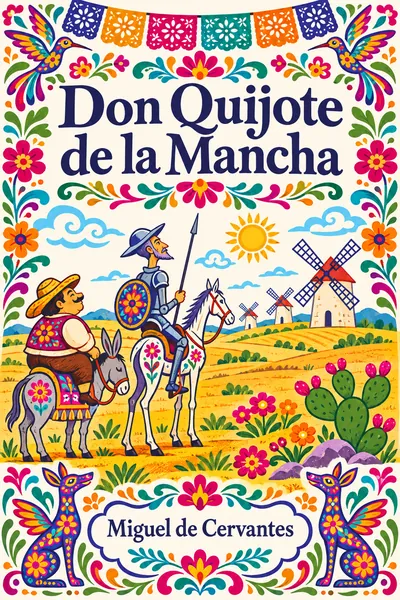
Don Quijote de la Mancha
The most famous book in Spanish. Read an adapted version first, then the original chapter by chapter: the windmills are in Part One, chapter 8.
What it's about
Alonso Quijano, a minor nobleman from La Mancha, reads so many books of chivalry that he decides to become a knight himself. He renames himself Don Quijote, picks the farm girl Aldonza Lorenzo as his ideal lady «Dulcinea del Toboso» and rides out on his old horse Rocinante. A farmer, Sancho Panza, joins him as his squire, tempted by the promise of an island to govern. Don Quijote sees giants where there are windmills and armies where there are sheep, and the two get beaten, tricked and laughed at again and again. Part Two (1615) is darker and even funnier: by now everyone has read Part One, and people play elaborate jokes on the pair.
Resumen en español fácil
Tap any underlined word for its meaning
Don Quijote es un hidalgo que lee tantos libros de caballerías que pierde la razón. Decide ser caballero andante y sale de su pueblo con su caballo Rocinante. Un campesino, Sancho Panza, se va con él como escudero. Don Quijote ve gigantes donde hay molinos de viento y ejércitos donde hay ovejas. Sancho, más práctico, siempre intenta explicarle la realidad, pero poco a poco también empieza a soñar.
Main characters
- Don Quijote — a gentleman of almost fifty who believes he is a knight from the books he loves
- Sancho Panza — his down-to-earth squire, full of proverbs and common sense
- Dulcinea del Toboso — the lady Don Quijote imagines; in reality a farm girl who never appears
- Rocinante — his skinny old horse
How to read it in Spanish
The original is long and written in 17th-century Spanish, so few learners finish it first time. Start with an adapted version for your level (there are good A2–B1 editions), then read famous chapters in the original: the windmills are in Part One, chapter 8.
Where to read it
The novel is in the public domain, so free legal copies exist: Project Gutenberg and the Biblioteca Virtual Miguel de Cervantes both have the full text.